Two rulebooks, one video
Anyone publishing synthetic video today answers to two different sets of rules. The first is law: in the European Union, Article 50 of the AI Act sets transparency obligations for providers and deployers of AI systems. The second is platform policy: YouTube and TikTok each require creators to disclose realistic AI-generated or altered footage, and each enforces that requirement with its own tools.
The two overlap but do not replace each other. A video can satisfy a platform's disclosure toggle and still miss a legal obligation, or the reverse. Teams that treat the upload checkbox as compliance find the gap later.
What Article 50 requires
Article 50 of Regulation (EU) 2024/1689 (https://eur-lex.europa.eu/legal-content/EN/TXT/?uri=CELEX:32024R1689) covers several transparency duties. The European Commission's own summary of the transparency rules (https://digital-strategy.ec.europa.eu/en/factpages/quick-facts-transparency-rules-ai-systems) states that they apply from 2 August 2026 and lists the cases.
For video work, three matter. Providers must design systems so that people are informed when they are interacting with an AI system. Providers must ensure that synthetic audio, image, video, and text outputs are marked in a machine-readable format so their artificial origin can be detected. Deployers — the businesses actually using the system — must disclose deepfakes: content that resembles existing people, places, or events and could be mistaken for real.
The Commission published guidelines on the transparency obligations (https://digital-strategy.ec.europa.eu/en/policies/guidelines-transparency-ai-generated-content) in July 2026 to clarify scope, definitions, and exceptions, and a voluntary code of practice on marking AI-generated content exists alongside it. The guidelines are the practical document for building a disclosure step.
Not every use of AI triggers disclosure. Minor edits — color correction, noise reduction, cleanup that does not change what the footage shows — sit outside the deepfake duty. Fully synthetic material that is clearly stylized, such as an animated character in an obviously illustrated world, is treated differently from a realistic person speaking to camera.
The dividing line is plausibility. If a viewer could reasonably believe a real person said or did what appears on screen, disclosure is expected. If nobody could mistake the footage for reality, the calculus changes. This is why the same production team can ship an animated explainer with no label and a synthetic testimonial that needs one.
YouTube: the AI use setting
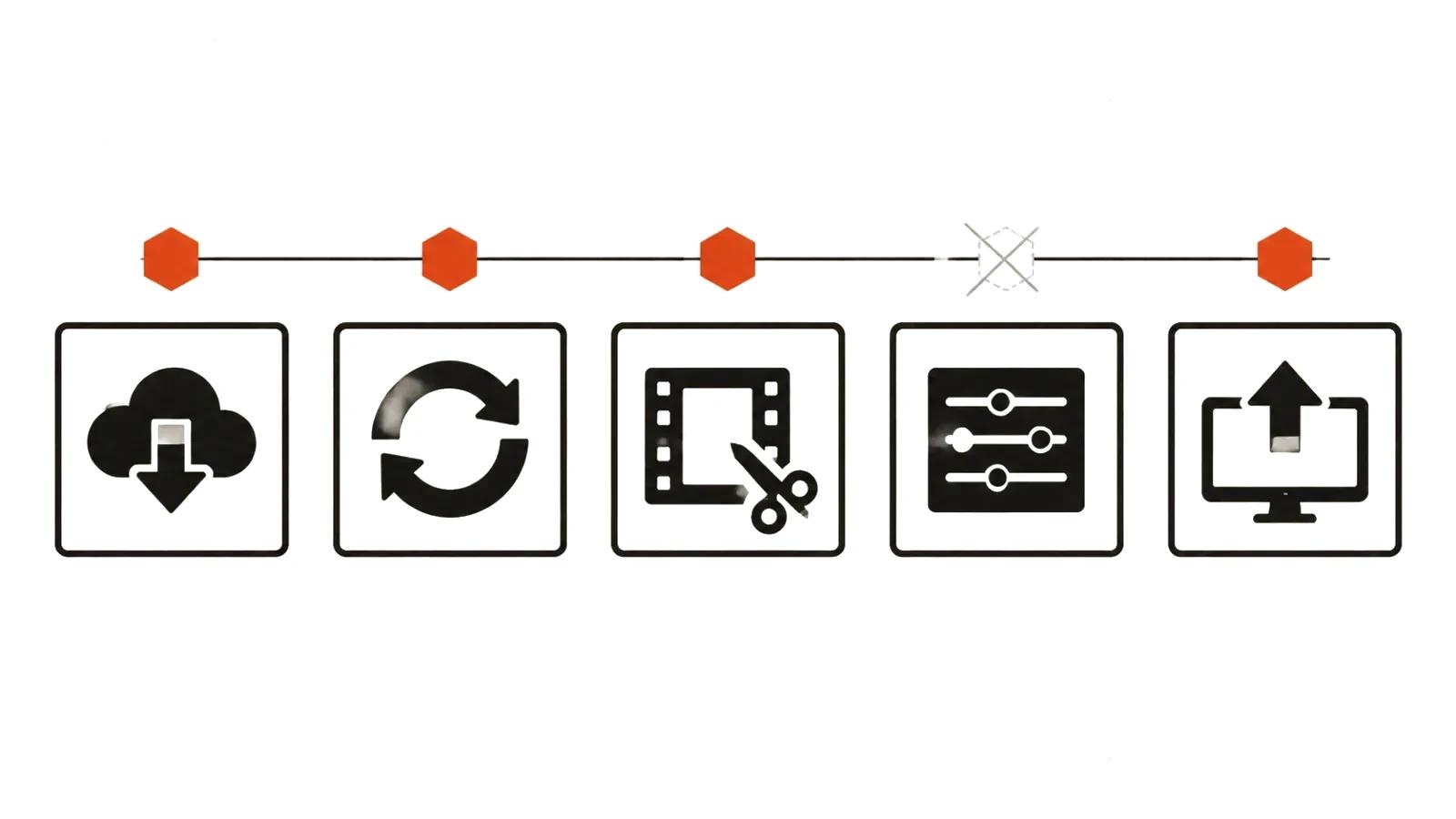
YouTube's help documentation (https://support.google.com/youtube/answer/14328491) is explicit: creators must disclose content that is generated or meaningfully altered with AI when it appears realistic. Disclosure happens during upload, through the "AI use" setting in Studio, and the result is a label shown to viewers.
The same page lists what does not need disclosure: non-realistic content and purely aesthetic edits that do not alter what the footage shows. A realistic scene that never happened falls inside the requirement.
The decision is made by whoever uploads, not by an automated system: twenty versions of a spot need twenty judgments.
TikTok: label or risk removal
TikTok's community guidelines (https://www.tiktok.com/community-guidelines/en/integrity-authenticity) require creators to label AI-generated or significantly edited content that shows realistic-looking scenes or people. The same section states that unlabeled content may be removed, restricted, or labeled by the platform, depending on the potential for harm.
Two details are worth noting for commercial work. First, the trigger is realism plus significance: a filter or a cosmetic retouch is not the target, a synthetic spokesperson is. Second, the platform reserves the right to apply its own label when a creator does not, which means an unlabeled ad can end up carrying a badge the brand did not design.
Why this lands on ad production
Advertising is where synthetic people, voices, and product shots concentrate. A single campaign can include a generated presenter, an AI voiceover, an animated pack shot, and a real testimonial. Each element has a different status, and the disclosure decision is per asset, not per campaign.
AI video production workflows also strip metadata by default: files pass through generators, editors, compression, and upload pipelines, and machine-readable marks do not always survive. A disclosure step that exists only at generation time often fails by the time the file reaches the platform.
Video versioning multiplies the problem. Ten variants of one spot produce ten files, each with its own provenance history, and re-encoding is where the marks disappear first.
Vertical video ads are the most exposed case. A synthetic presenter holding a product and talking to camera looks like a real shoot, and that is exactly what platforms ask about.
A workable labeling process
Start with an asset register. For each deliverable, record which model produced which element, whether a real person appears, and whether the result could be mistaken for unaltered reality. That table answers most disclosure questions without re-litigating at upload.
Then set the label at the latest possible stage, not the earliest. Platform toggles are applied at upload; visible on-screen disclosure, if the brand wants it, is added in the edit; machine-readable provenance is preserved by avoiding unnecessary re-encodes.
Finally, brief the media buyers. A label changes performance data, and a campaign that compares labeled and unlabeled variants is measuring two different things. If the test is about creative, keep the disclosure constant across cells.
Where the rules are still moving
Enforcement practice is young. The Commission's guidelines clarify intent, but case law is thin, and platform policies change faster than legislation. TikTok and YouTube both update help pages without notice.
Marketers should also expect divergence: a label that satisfies one platform may be invisible on another, and a legal disclosure in one jurisdiction may have no equivalent elsewhere. Building a single global "AI-labeled" master file is usually the wrong move; building a per-market checklist is the right one.
Before the next campaign, write down the disclosure rule your team follows, and make it specific to the kind of content you produce. Check the current help page of each platform you publish to, because the text changes. Keep provenance data intact where you can, and treat labeling as a production step with an owner rather than a checkbox somebody remembers at the end.
Russia, briefly
Russia passed its own framework law on AI in July 2026. Federal Law No. 243-FZ was signed on 26 July 2026, entered into force on 1 September 2026, and its marking provision — Article 9 — applies from 1 March 2027. Article 9 gives the person using a large foundation model the ability to attach an AI notice to audio or visual material; the duty to provide that technical capability falls on sites and information systems with more than 500,000 daily users in Russia where advertising can be distributed.
A separate bill, No. 1317978-8, was introduced in the State Duma on 17 August 2026 and would move marking obligations onto the services that provide access to models. It has not been adopted.