
One call to action
Hook, problem, product in action, proof and one action. For Mobile apps.
An app promo does not sell graphics, it sells the first tap: the viewer sees what to press and why it matters. The screen in frame has to be the real product, everything around it is built without a shoot day.
An app promo does not sell graphics, it sells the first tap: the viewer sees what to press and why it matters. The screen in frame has to be the real product, everything around it is built without a shoot day.
Hook, problem, product in action, proof and one action. For Mobile apps.
For a meeting, a website or a sales deck.
From a product card to an email. Each placement gets its own cut.
A finished video with rights to the files.
You approve the script and the character. We do the rest and show you progress along the way.
The goal, the audience, where it will run and your references. That is enough to start.
We agree on the story and the frames before production, so the quote is clear upfront.
A person reviews every frame. We rerun the motion until it lands.
Editing, music, voice and captions. Music is composed for the job.
The finished video plus versions for each platform. The rights are yours.
A factory example of a clip in this format, not a client case for a mobile app: AI generation (text-to-video, 1080p, 12 s), a steak in sauce in close-up and the camera pulling back to the evening dining hall; re-encoded with ffmpeg.
Frames from internal batches. Client names stay hidden, we work under NDA.
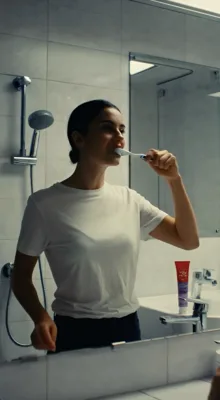

A promo video for a mobile app covers three jobs at once: the store preview, the creative bought in paid traffic and the explanation of the product on the website. Screens and transitions are captured from a working build or assembled from Figma files, while the device, hands, background and 3D icons are generated. 9:16 and 16:9 cut from one scene, a handcrafted film runs from $394 for up to 90 seconds, quoted after the brief.
An app needs three pieces of work, not one. The store preview sits on the download page and must show the product itself: the viewer came to understand what the app does, not to watch a pretty scene. A paid-traffic creative lives for three seconds, is scrolled without sound, and stands on its first frame and its caption. The website and onboarding film explains how the product thinks and is made for people already interested. They cannot be merged into a single file: each has its own length, its own requirements and its own metric.
Generating everything is tempting: it is fast and needs no access to the build. With an interface it fails. A generated screen always drifts: labels change, buttons resize, blocks reorder, and the first note from a store reviewer or from support lands exactly there. So the line runs along the interface: the product is real, everything around it is generated, and that is what saves the shoot day.
| In frame | How we make it |
|---|---|
| Screens, transitions, taps, scrolling | captured from a build or assembled from Figma files |
| Device in hand, desk, cafe, street | generation from your references |
| Product icon, 3D objects, abstract panels | generation and motion from the brand guide |
| Real users on camera | filming with written consent |
| Reviews, rating, install count | the client's real data only |
A paid creative is watched without sound with a thumb ready to scroll, so the script is written for a silent view. The first frame shows a situation the viewer recognises: a queue, an empty fridge, a booking nobody confirmed. The second frame gives the action at once: one tap, a large button, a clear result on screen. Then one line of benefit and the call. Anything that cannot be read in a second and a half leaves the creative and moves into the website film.
One video does not answer which argument works. So production is built as a set: one scene, one set of screens and several opening frames. The hypotheses are plain and testable: speed, price, simplicity, trust, locality. Then we look at which combination holds retention and sends people to the store, and we drop the weak ones instead of rebuilding the whole package. That costs less than one staged shoot which would have to be changed anyway.
Stores accept vertical and horizontal, but not square, so a preview is built in two versions of one scene with no letterbox bars. The feed and short-form apps need vertical, the website and YouTube need horizontal, and grid placements take square. Title-safe areas are planned in advance so the player buttons and the platform's own captions never cover the button inside the app.
| Placement | Ratio | Job |
|---|---|---|
| Store download page | 9:16 or 16:9 without bars | show the product before install |
| Reels, Shorts, TikTok | 9:16 | reach and a tap to the store |
| Website, YouTube, deck | 16:9 | explain the whole product |
| Grid placements | 1:1 | a short repeat impression |
An app changes more often than an ad budget: a new screen, a renamed tab, a different onboarding. Nothing has to be shot again. The scene template stays, the screen is recaptured and drops into the old slot, and the setting plus captions keep the recognition. That is why refreshing a preview after a release costs less than the first film, and the timeline is fixed separately in the brief.
It starts with a brief: what the app does, who pays, where you advertise, which screens exist in the build. Then access: a test build for capture or the Figma files. Unreleased screens and features are covered by an NDA. The script and storyboard are approved before production, because a revision at that stage costs less than recutting a finished film.
We promise no top placement in a store, no percentage growth in installs and no lower cost per install: price, audience and the product itself decide those, and the video only carries the offer. We do not present someone else's interface as the client's, and we do not draw a rating that does not exist. We have no app case with figures, and we do not move numbers from other projects onto an app.
A promo video for an app is priced as handcrafted work: from $394 per video of up to 90 seconds, the first cut in about a week, editing and music included. A set of creatives, localisation and versions for several placements are quoted separately, because they depend on the number of screens and hypotheses. We assemble the exact estimate after the brief and fix it in the contract.
No, if the product has to be in frame. The interface is captured from a working build or assembled from approved designs: a generated screen drifts in its labels and layout, and such a preview is rejected at store review or simply does not match what the user sees after installing.
A handcrafted video runs from $394 for up to 90 seconds, with the first cut in about a week and editing plus music included. A set of creatives and versions for several placements are quoted separately, since the figure depends on the number of screens, hypotheses and languages. The exact estimate comes after the brief.
Yes, under an NDA: we capture a test build or assemble the screens from the designs. It stays a product in frame, not a concept, so half-built features are not added even if they will ship by release.
Usually not. The store requires the product to be shown and limits the length, while a paid creative stands on its first frame and is made for a silent scroll in the feed. Versions are cut from one scene, but with different length, opening frame and captions.
Faster than the first one: the scene template and the setting stay, only the screen is recaptured and the captions change. The exact timeline depends on how many screens changed and is fixed in the brief before work starts.
Music is licensed only, and a chart track without rights never goes into an ad. Where the law requires disclosure, the advertiser registers the data and the token; we cut the creative so the marking fits without a re-edit.
Real people are filmed with written consent, and conversations, names and personal data on screen are masked. Reviews and ratings come only from the client's own data: a drawn rating breaks trust and the platform rules.
We price your task on a call
Tell us about the product, the market and the platforms. That is enough for a quote.
We'll say how many videos you'll get, at what price and by when.
what happens next