What a creative is in practice
A creative is the unit of delivery: the file a platform drops into a feed or in front of a video. A film shot for one placement loses a frame, a line of text or its opening seconds when it moves somewhere else.
Hence a working definition. A creative is a film built for a specific placement. A renamed copy of the same file does not qualify.
The difference shows in reporting. A campaign with one file returns an average and no answer about what worked. A campaign with several versions returns an answer, provided you change one variable at a time.
What the official documentation claims
Google Ads Help describes four principles for video ads: attention, branding, connection and direction. The same page states that applying these guidelines can deliver up to a 30% lift in short-term sales likelihood and up to a 17% lift in long-term brand contribution.
Those numbers belong to Google and Kantar, and the page cites a study from April 2021. I quote them as a company claim, with no independent measurement behind them.
The framework is the more useful part. Attention: hook immediately, reinforce with audio and on-screen text, remove competing elements. Branding: show the brand early, often and clearly. Connection: narrow the message, add emotion. Direction: one clear next step, backed by voice.
Each item is a separate variable. Versions exist so you can test one at a time.
How many versions make sense
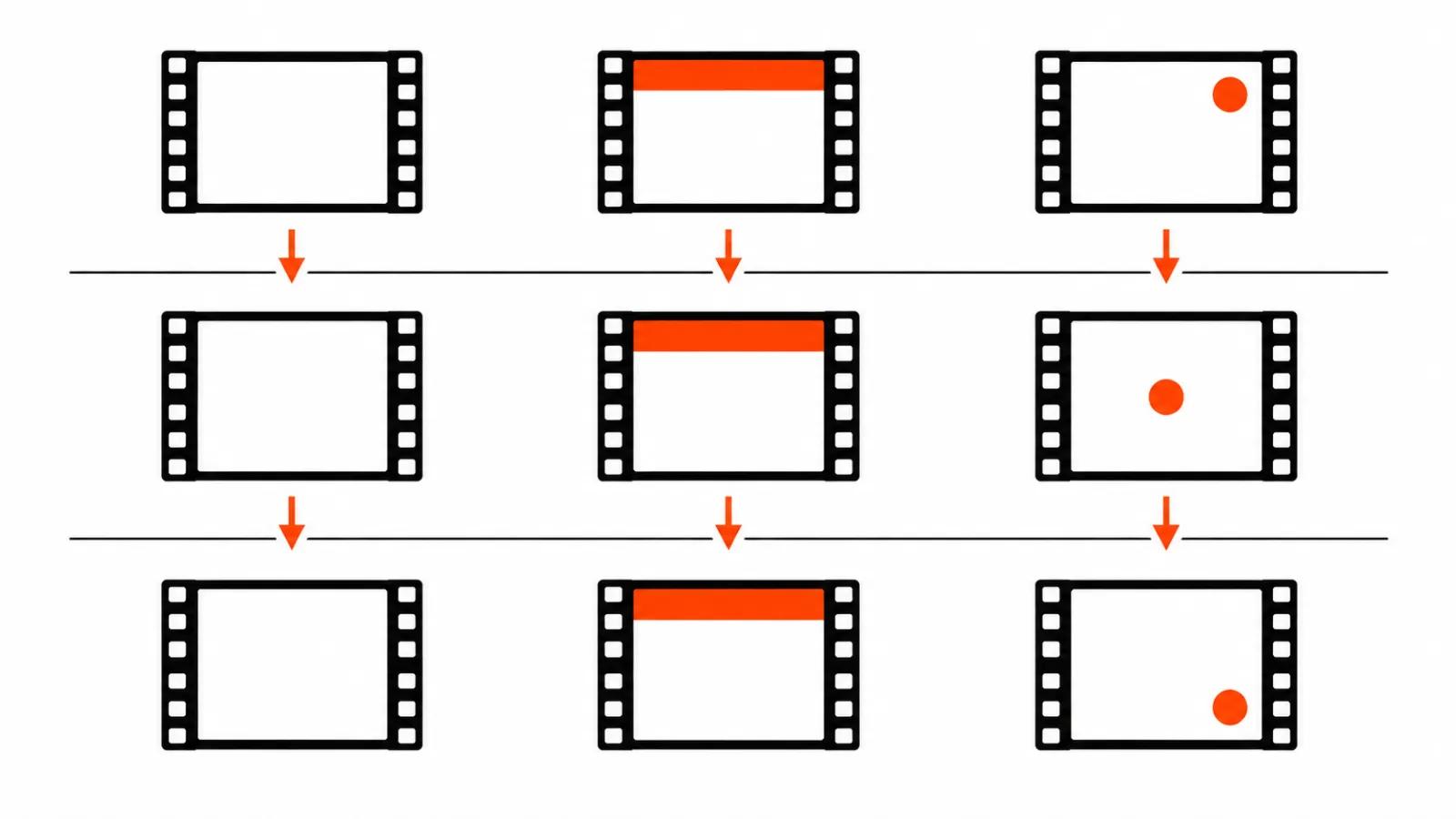
A practical minimum for one placement is three files: a baseline, a version with a different opening frame, and a version with a different call to action.
The reason is simple. The first frame decides whether anyone watches. The call decides whether anyone acts. Two different decisions from the viewer, and one file cannot separate them.
From there the count grows with placements. Three placements at three versions each gives nine files, which is a sane volume.
The ceiling is set by production. Past ten versions, the scarce resource becomes review time.
What changes between versions
The first two seconds. A different subject, a different kind of motion, a different on-screen line.
Length. Google Ads Help sets different limits by format: bumper ads run six seconds with a five-second minimum, non-skippable ads from fifteen to sixty, and Shorts ads are recommended under sixty seconds.
Shape. Vertical, square and widescreen are three different frames. The same footage needs different framing in each, or the vertical cut loses the point.
The call. "Book a slot", "browse the catalog" and "check the price" ask for different levels of commitment.
Proof. A number, a review, a product demo. This one is hardest to vary, because it needs a shoot or dedicated graphics.
What stays identical
Brand, palette, typeface and overall tone. Change everything at once and the result belongs to no variable in particular.
Keep the sound consistent too: one voice, one musical motif. Viewers recognize a film by its audio before they recognize the picture.
The product should stay the same. Different angles of one item are fine. Different items in one campaign are a different conversation.
How this looks in production
When versions come from one body of footage, editing is the cheap path: different opening frames, different titles, different endings. That is how vertical video ads run in campaigns built on volume. For large runs, short-form video at scale treats the version as a production parameter. With no footage at all, assembly happens through AI video production, where versions differ by prompt and first frame. It also helps to check how video ad lengths by placement differ, so one file does not get pushed everywhere.
| What you test | What changes | What you hold |
|---|---|---|
| Attention | opening frame, motion | brand, sound, product |
| Clarity | on-screen text | editing rhythm |
| Action | call to action, button | opening seconds |
| Recall | when the brand appears | film length |
Where extra versions do not help
When the product is unclear. Five opening frames will not rescue a film where nobody can tell what is on sale.
When the campaign has run out of reach. New creatives do not expand an audience the platform has already exhausted.
When versions differ in everything at once. That test produces a pretty table and zero conclusions.
When creatives outnumber traffic. At low impression counts the gap between files stays inside noise, and the winner gets picked by a coin toss.
How to read the result
Watch two things: completion and the target action. The first speaks about the opening frame, the second about the call.
Intermediate metrics are only useful as an explanation. A click without a sale can mean the promise in the film and the landing page disagreed, and then the creative is not the problem.
One last point. A version that lost in one placement can win in another. Store results per placement. A campaign-wide average explains nothing.