Kling 4.0 Flash opens up: access and limits
On November 4 Kuaishou lifted the gates on Kling 4.0 Flash. The model now sits on the Kling AI site and in the public API, with MCP, a command line client and plugins for outside software alongside it. The Kling plugin installs into Photoshop, Premiere Pro and After Effects.
Until that day Flash lived inside the Ultra Yearly plan, the Black Gold tier, from September 28. There was no public API and no published price: the model came as a bonus on an expensive subscription, and only a subscriber could test it on their own scenes.
The limits after the opening: 3 to 20 seconds, 720p only, 8 bit SDR, an English prompt of up to 26,000 characters, up to 10 reference images and 5 reference videos, up to 15 inputs in Omni mode. The modes sit on three endpoints, each carrying kling-4.0-flash in the path: text-to-video, image-to-video and omni-video.
Why this matters: an open API removes the main barrier. Flash can go straight into a pipeline and be tested on your own shots without buying a yearly plan for a single check.
The price per second, and a trap with input video
Kling bills in units, and a unit runs about $0.157. Flash charges 0.6 units per second with no input video, which lands near $0.094 a second of generation.
With an input video the rate drops to 0.4 units, about $0.063 a second. There is a catch: when the input is no longer than the output, billing doubles against the output duration. A ten second clip made from a ten second clip costs $1.26. A plain generation of the same ten seconds costs $0.94.
Full Kling 4.0 is dearer: $0.157 a second at 720p and $0.235 at 1080p. Flash has no 1080p and no 4K, and the rate card has no audio row, so it will not carry a final frame for a client.
The rate breakdown went up on the OrcaRouter blog on November 4, AIBase repeated the numbers on November 5, and the official Kling AI account confirmed the launch. Independent benchmarks for Flash are not out yet, so any quality comparison rests on the vendor's own demos.
Why this matters: 9.4 cents a second is a draft price. Ten alternate takes of a ten second scene cost about $9.40, and that turns testing into a routine. Cheaper to render a batch of options and pick on the timeline.
AI video news: generation moves into the edit
A plugin inside Photoshop, Premiere Pro and After Effects means generation arrives in the same project where the cut is being built. A shot can be generated in the middle of a timeline without jumping to a website and dragging files by hand.
For an editor that means fewer manual transfers: the generated shot sits in the project next to the source footage. A side benefit is housekeeping, since intermediates stay in the working folder. Kling has not described how the plugin returns a clip to the timeline, so test it on a live project.
OpenAI Images 2.6: a GIF from a prompt in nine frames
OpenAI introduced Images 2.6 on November 4. The model runs in ChatGPT, Codex and the API, builds a GIF from a text prompt or from an uploaded photo, and image generation got 50% faster by the company's own account.
The API ships two versions. GPT-Image-2.6 Flare is the fast one and returns a frame in roughly 6 seconds at low quality. Sunburst holds quality and consistency at medium and high.
The GIF parameters look like this: output_format gif, frame_count from 2 to 64 with a default of 9, frame_duration_ms from 20 to 2000 with a default of 200. In ChatGPT the team added playback speed for GIFs and editing of individual frames.
OpenAI cites 4 billion images a week. This model does not make video: Sora is gone, the app on April 26, 2026, the API on September 24, 2026.
Why this matters: nine frames by default is close to a finished animatic. A storyboard for a client can be cut before the project holds its first second of footage, with pacing agreed on still frames.
Luma's Character Sheet: the character stops drifting
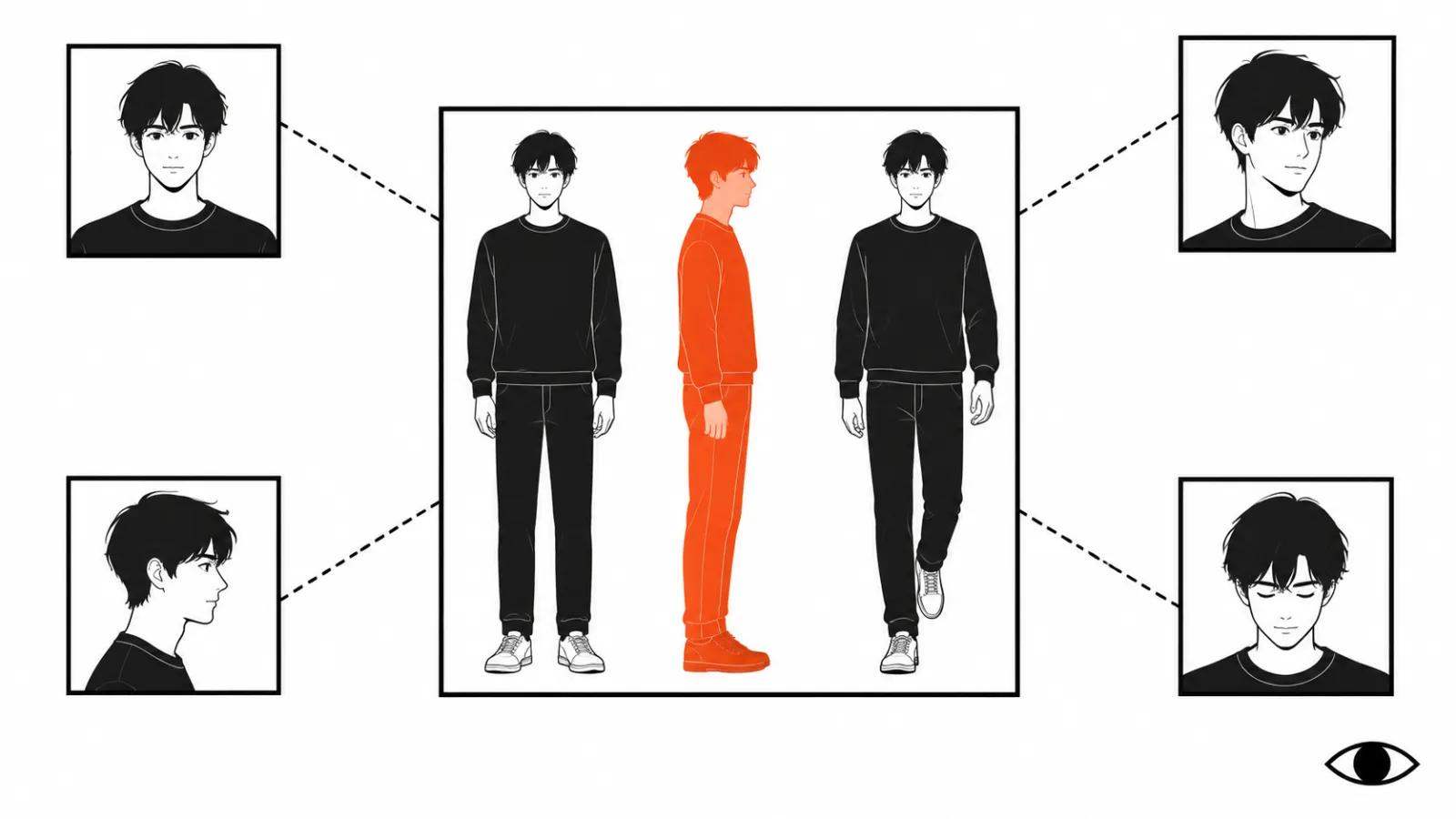
The Luma Labs account showed Character Sheet on November 4. The tool gathers scattered reference images into a single character sheet, and in multi-view generation the face, clothing and proportions drift less from shot to shot.
The announcement lists no price and no limits, only the job the tool is meant to do. A character sheet alone tells you little about the result: this kind of thing gets checked on a run of ten shots, where the profile view and the wide shot show how the model holds a face.
Why this matters: character drift is the main driver of retakes in ads with a person in frame. If the sheet really holds the face, the most expensive block of fixes leaves the quote, and a series built around one hero gets cheaper to produce.
PixVerse: swapping subjects with a depth map
The PixVerse account showed motion control driven by depth on the same day. A reference video is uploaded as depth control, the character, object or scene is swapped, and the movement path stays the one from the source clip.
The company named no price and no limits. The trick is familiar: movement gets carried over from a reference when staging the stunt for real is slow and costly.
Why this matters: a depth map holds camera travel and body motion, and a lot of advertising built on a stunt rests on exactly that. Worth testing on your own references, since vendor demos rarely show how the model behaves through fast passes and turns.
What this AI video news changes in practice
Two moves in one direction and one in another came out inside a day. First direction: generation gets more predictable and closer to the edit, through the Adobe plugin and Luma's character sheet. Second: a cheap draft, Flash at 9.4 cents a second in 720p. The GIF from OpenAI closes a third stage, the storyboard that used to live on hand drawn thumbnails.
The pipeline conclusion is plain. A draft on Flash, a character sheet from Luma, a storyboard as a GIF, a final on the full model. Each step now costs its own money and needs its own tool, and the quote shows it in the number of retakes.
What to do this week: take a scene you have already produced and run it on Flash in ten versions, which at 20 seconds comes to about $18.80 for all ten. Then compare against the full model and write the gap down. One example, the November 4 roundup on Wan 3.0 and editing, shows how fast the top of the table moves, so price is the steadier reference right now.
For client work the conclusion is simple. Where a final frame and exact lip sync matter, it pays to do the job properly from the start: handcrafted videos start from $190 for a finished piece, and that is the most predictable line in a quote. A stream of vertical videos, where AI video production runs in batches, rests on a different sum, up to $2.40 per 1000 views. Access and the rate difference are covered in our piece on Kling 4.0 access, units and 1080p included.