What changed in the holiday campaign
For two years running, Coca-Cola built its holiday work on generative AI. In 2023 the brand offered an AI holiday card generator online. In 2024 it released AI remakes of its Holidays Are Coming spot. In 2025, already under criticism, it put out another AI commercial with snowy landscapes and local elements bought by geography, including a Welcome to Boston banner in Boston.
The new spot works differently. Enjoy Joy shows real actors playing friends and family through autumn and winter activities: American football, a turkey at dinner. It closes on the word Enjoy, set in a new, tall serif typeface. Paul Dektor directed, Mayan Productions produced. A Coca-Cola spokesperson told Fast Company the ad was made without generative AI.
The campaign itself continues. Enjoy Joy follows last year's Refresh Your Holidays, which positioned the drink as the connecting point between people over the holidays. What changed is how the spot was made, and how much trust the picture asks for.
Why AI advertising worked on paper for two years
The generative campaigns had their own logic, and that logic rested on numbers. Pratik Thakar, Coca-Cola's global lead for generative AI, said the ads passed the company's internal holiday benchmarks and proved what personalized programmatic content could do at scale. One master spot travelled to cities through geo-bought local edits.
The trouble is that a benchmark measures delivery while an audience measures believability. A spot can hit every impression target and still start a conversation about why a brand built on warmth assembled its warmth from generations.
The wider picture in 2026 backs this up. Brands spent the year trying to prove their advertising was not AI, while public opinion turned against the technology. Apple, Levi's, Prada and others chose an analog, handcrafted approach.
What Coca-Cola actually says
The company's position, as given to Fast Company by spokesperson Madison Chandler: "Human storytellers remain at the center of the creative process, with AI serving as a tool to support and enhance creative expression where appropriate." The same response says this is not a signal of a broader reversal, and that the company keeps trying different creative approaches and new technology.
That quote contains two statements, and the second one matters more. People at the center of the process is a position nobody argues with out loud. "Where appropriate" admits something else: the tool has limits, and the brief decides where they sit.
Read the answer literally. The company is not abandoning generation, because an outright retreat would be a different story. What moves is the layer where AI is allowed. It leaves the close-up and stays in work the viewer does not inspect.
Visible AI and invisible AI, from the viewer's seat
Nobody in the audience checks how a frame was made. They read faces, hands and food, then decide.
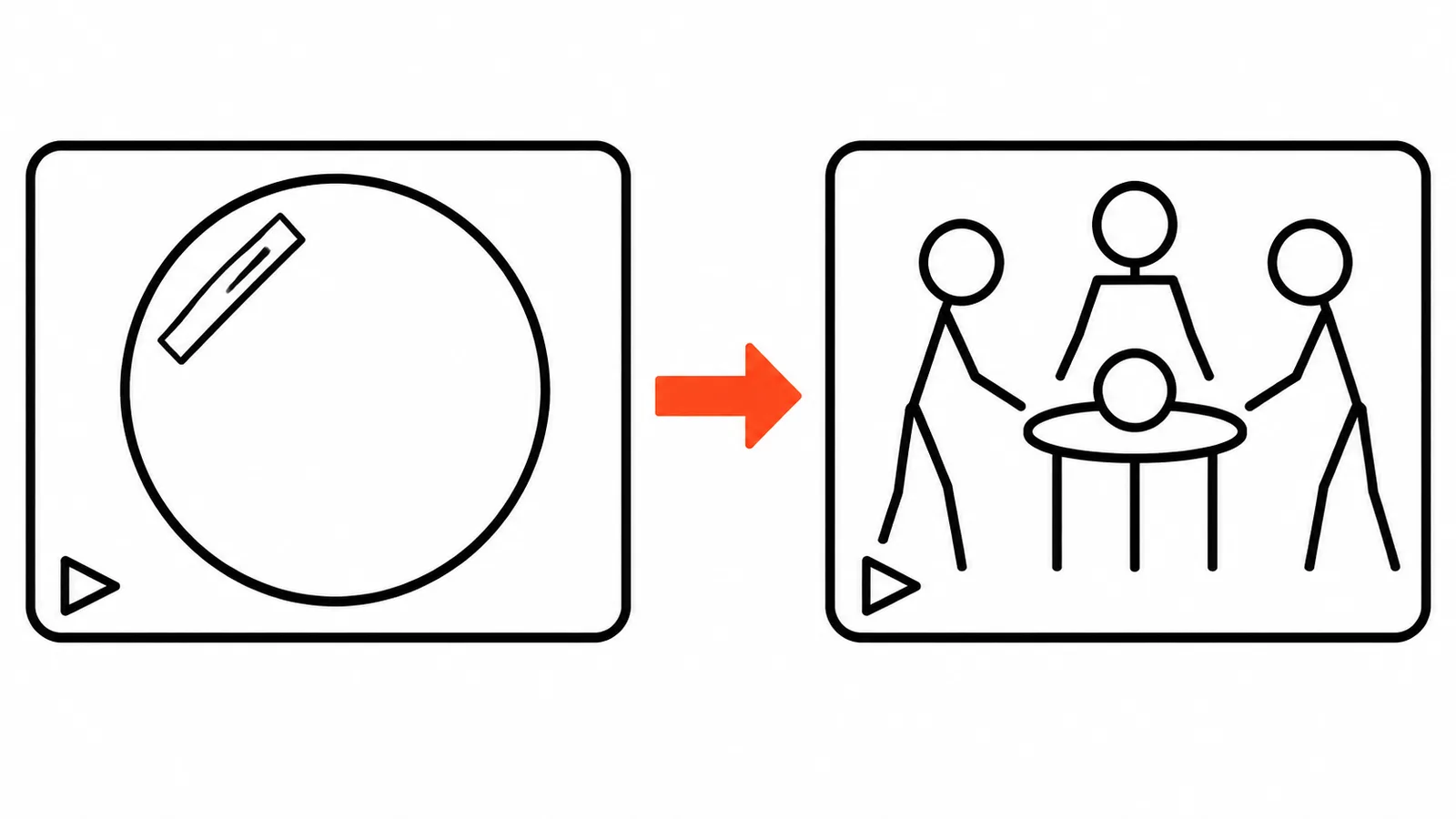
Visible AI gives itself away wherever the world has physics. Skin without pores, lit evenly from every side. Fingers that grip a glass without shifting. A turkey that does not give under the knife. Lettering on a banner where the letters drift toward the end of the word. Together these details produce a feeling of forgery the viewer cannot name.
Invisible AI works the other way round: the question never comes up, because the frame offers no reason for it. What separates cheap generation from expensive work is the count of frames somebody watched in review.
Visibility also depends on the screen. On a cinema screen a face fills much of the frame, and any slip in expression reads instantly. A vertical ad shows the same frame on a phone held at arm's length, where the face is the size of a thumbnail.
Three places AI still earns its place, and one where it hurts
First: one shoot, many versions. A local banner for a specific city, alternative endings per platform, many cuts from a single frame. Generation does work here that live shooting does slowly and expensively, and each viewer only ever sees their own version. The Welcome to Boston banner from 2025 shows how this looks at brand scale.
Second: the frame that does not exist. A period scene, a product in an interior nobody can rent, a macro shot no lens can reach. AI has no competitor here.
Third: utility layers. Bumpers, lower thirds, backgrounds, logo animation, transitions. Viewers do not treat these as pictures, so they never grade them on believability.
The one place AI hurts: a spot whose message depends on believability. A holiday story about family. A warm AI video ad about people, where the hero looks into the lens and speaks for themselves. If the campaign argues that the brand stands next to real people, generated faces argue the opposite. The trouble sits in the genre, where believability is the whole argument.
AI labeling in ads, and what a disclaimer can fix
Labeling rules for AI content differ from market to market, and each set applies from its own publication date.
For a brand that means one simple thing. A label removes the question of deception. It does not remove the question of quality. A "made with AI" tag under a poor frame makes things worse, because the viewer gets both the suspicion and the confirmation.
AI content labeling rules cover the legal side in detail, and AI video marking under the EU AI Act covers the European deadlines for anyone publishing in that market. Once a campaign has many versions, ad creative versions take on a life of their own: every placement has its own format and every version its own lifespan. Labeling then has to be handled per file, and it belongs in the brief, before the edit starts.
What a brand without a shoot budget should do
A small brand has no money for a stage, lights, talent and a crew day. That is not a death sentence. It has a choice between bad AI and good AI, and that choice is made in craft.
Cut the shot count. A few well-built frames look more expensive than many average ones.
Shoot the cheap things live. Hands, a table, the product, a window, a cup. A phone on a tripod and one window produce material generation does not reproduce in texture. AI stays on the frames that are not in the room.
Put the remainder into sound and edit. A weak voiceover gives away AI faster than any hand in frame.
Plan a series of spots instead of one. A handcrafted video up to 90 seconds starts from $190, and that covers frame-by-frame review, editing and music. A stream of vertical videos is priced differently: up to $2.40 per 1000 views. When the spot has to land on a promotion with a date, timing beats texture, and a promo video built on a locked script gets there faster.
How to check your own spot for visible AI
The check needs no gear and no long preparation.
The most common mistake in this check is watching on your own monitor at full screen while knowing which shot is which. An audience watches once, without pausing, on a phone.
- Speed. Drop playback to 0.25x and walk the whole spot. At slow speed a hand lives separately from the body, and eyes fail to blink with the speech.
- Sound. Mute it and watch the lips. Then unmute and listen for whether speech lands on articulation at the consonants.
- Text. Read every piece of writing in frame. The label, the sign, the packaging, the phone in the hero's hand.
- People. Count how many people in frame move their eyes and change expression.
- The seam. Find the join between a generated shot and a live one. Light and grain give it away.
- A stranger. Show it to three people without saying how it was made.
What follows from it
Coca-Cola marked a line that used to be blurry. A brand can use generation and still know where it shows. A holiday spot is the place where everything shows: faces in close-up, emotion at the center, an audience primed to believe.
For everyone else this is a test on genre. If the message rests on believability, generation has to stay invisible to the last frame. If the message rests on an idea, a geography or a scale, AI remains a tool, which is exactly what Coca-Cola calls it.